


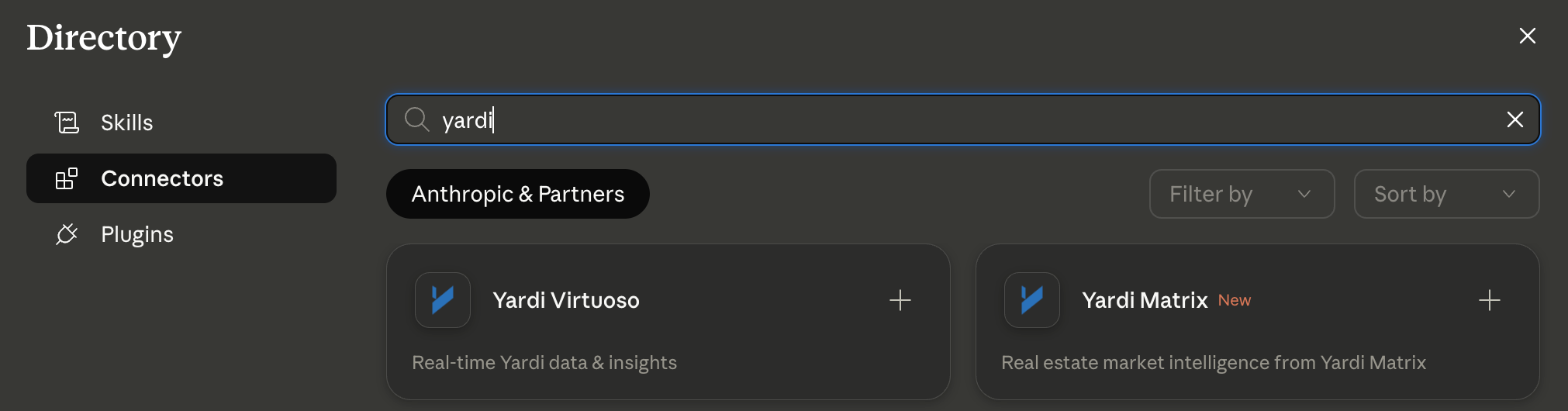
Astute Claude users in commercial real estate might have recently noticed two intriguing new connectors: Yardi Matrix and Yardi Virtuoso. Yardi's announcement of Virtuoso Connectors for Anthropic's Claude, built around the Model Context Protocol, signals that for Yardi users, AI-assisted work is moving closer to the data and workflows property teams rely on every day.
That shift from standalone demos to system-connected work was also the clearest signal in our AI in Real Estate Summit takeaways, where governed context emerged as the requirement for useful operating AI.
If an AI assistant can work with market intelligence, portfolio context, reports, or operating workflows, teams need clean data, role-appropriate permissions, consistent reporting definitions, and clear review points. AI adoption enablement for real estate operators starts with workflow and governance design before a tool-first pilot.
Key takeaways
- Yardi Matrix and Yardi Virtuoso Connectors are live in Claude's directory as of June 2026.
- Yardi Matrix is oriented around market intelligence and portfolio research while Yardi Virtuoso is designed to deliver real-time data and insights from Yardi.
- The operator work is still familiar: data readiness, permissions, reporting definitions, workflow ownership, and governance.
- Teams should confirm current availability, supported Yardi products, and rollout path directly with Yardi before planning internal change management.
What Changed With Yardi And Claude?
The practical change is that Claude now has Yardi context in its connector ecosystem. For property teams, that is the important signal. Instead of treating AI as a generic drafting tool that sits outside the system of record, operators can start evaluating where a Claude workflow could answer Yardi-aware questions, summarize relevant context, or point a user toward the right market data, report, record, or next review step. For broader context on Yardi's AI layer, see our Yardi Virtuoso guide.
Useful starting points are the recurring questions teams already ask. Asset managers can evaluate market and portfolio research before an investment meeting. Regional operators can look at ways to understand what changed across a group of properties. Accounting and operations leaders can explore whether Yardi Virtuoso can help review exceptions, compare performance, or prepare approvals with clearer Yardi context.
For a property management company, the useful next step is not a broad AI pilot. Pick one workflow and define how the connector should help: which question Claude should answer, which Yardi data or market context should be available, which report or record is authoritative, what the user should do with the answer, and when a human review is required.
What MCP Means For Yardi Users
The Model Context Protocol is an open protocol for connecting AI applications with external data sources and tools. In plain operating terms, MCP is part of the connective tissue that can let an AI assistant work with business context instead of staying isolated from the systems people use every day.
For Yardi users, that distinction is important. AI that is disconnected from your property management system can draft, summarize, and reason in general terms. AI that is connected to governed Yardi context is far better equipped to answer more specific questions about portfolios, markets, workflows, or reports, depending on what the connector supports and how access is configured.
That's also why AI readiness can't be treated as a side project owned only by IT. Accounting, operations, asset management, leasing, maintenance, compliance, and executive stakeholders all define what "good answer" means in their domain. If those definitions are inconsistent before AI enters the workflow, the assistant may simply make the inconsistency easier to ask about.
Yardi Matrix vs. Yardi Virtuoso In Claude
The two Claude connector listings point to different kinds of use cases: Yardi Matrix is market-intelligence oriented, while Yardi Virtuoso is broader Yardi data and workflow oriented. Every organization's experience will depend on current Yardi fit, supported products, and internal access decisions, but the connector pages do help teams ask better questions.
| Claude connector listing | What it appears to support | Operator readiness focus |
|---|---|---|
| Yardi Matrix | Market intelligence, property and portfolio research, rent and occupancy trend questions, benchmarking, and acquisition-oriented analysis. | Market definitions, asset classification, portfolio segmentation, research assumptions, and review of external-facing conclusions. |
| Yardi Virtuoso | Real-time Yardi data and insights, with Claude's listing showing read and write capability. | User permissions, operating workflow boundaries, reporting definitions, action review, audit expectations, and change management. |
The most useful internal conversation may be the distinction between analysis and action. Market intelligence questions can still influence investment decisions, asset strategy, and stakeholder communication. Operating-data questions can influence day-to-day property workflows. Any workflow that moves from answering a question to changing a record, initiating a task, or influencing communication needs a higher standard of review.
What Yardi Users Should Review Before AI Touches Operating Data
Most property management teams already have some version of the controls they need. The challenge is that those controls were often designed for human users navigating screens, reports, and workflows. AI connectors introduce a different interaction pattern: users ask a question or request an outcome, and the assistant decides how to use the available context.
Before a team pilots connector-based workflows, we would review five areas.
1. Data quality and definitions
AI assistants are only as useful as the context they can trust. If property names, entity structures, unit statuses, charge codes, market categories, GL mappings, or custom fields are inconsistent, the assistant may surface the confusion faster than a standard report would. Our AI data readiness guide walks through the data domains property management teams should inventory first.
2. Permissions and role design
Connector access should reflect how people actually work. A regional manager, property accountant, asset manager, leasing leader, and executive may all ask useful questions, but their data visibility and influence should match their role. This is where user-role design becomes part of AI governance and system administration.
3. Reporting logic
If an assistant answers a portfolio performance question, which NOI definition is it using? Which occupancy measure? Which date range? Which entity grouping? For many teams, the AI planning exercise will expose report-definition debates that already existed in Excel workbooks, custom reports, dashboards, and board packages.
4. Workflow ownership
Every AI-assisted workflow needs a named owner. The owner is the person accountable for whether the workflow is accurate, appropriate, reviewed, and adopted by the team. That is especially important for workflows involving resident communication, vendor activity, accounting review, compliance tasks, or executive reporting.
5. Human review and escalation paths
AI can reduce friction, but it should not blur accountability. Teams need to decide which outputs can be accepted immediately, which require review, and which should never be generated or acted on without a human decision. Our AI governance guide for property management covers the policy and review structures that help make those boundaries visible.
How To Talk With Yardi About Availability And Fit
Because connector availability, supported products, and rollout details can vary, teams should confirm current fit directly with Yardi before building an internal roadmap. The best conversation is specific. Bring your intended use cases, the Yardi products involved, the user roles that would need access, the data domains involved, and the review requirements your organization already follows.
Our Yardi Virtuoso workflow-planning checklist gives operators a concise set of availability, permissions, data, training, and change-management questions to bring to that conversation.
Useful questions include:
- Which Yardi products and data domains are supported for our environment?
- Which user roles can access connector-enabled workflows, and how are permissions enforced?
- Which activities are read-only, and which can initiate or change work in a connected system?
- How should our team review outputs before using them in reporting, communication, or operational decisions?
- What internal training and governance should be in place before expanding beyond a narrow pilot?
This is where implementation planning matters. The technical connector is one part of the picture. The larger work is mapping AI-assisted activity to the operating model: who owns the workflow, which data sources are reliable, which reports are authoritative, how exceptions are handled, and when a human review step is mandatory.
Yardi's new Claude connectors are a signal that property management AI is moving closer to core operating systems. The firms that benefit fastest will be the ones that already know where their Yardi data is reliable, where their permissions are thoughtfully designed, and where their workflows can support careful automation.
Frequently Asked Questions
Does Claude have Yardi connectors?
As of June 2026, Yardi Matrix and Yardi Virtuoso connectors are listed in Claude's connector directory.
What is MCP?
MCP stands for Model Context Protocol. It is an open protocol that helps AI applications connect with external data sources and tools. In a Yardi context, the important question is how governed Yardi data and workflow context can be used by an AI assistant.
What is the difference between Yardi Matrix and Yardi Virtuoso in Claude?
Yardi Matrix is designed to deliver real estate market intelligence while Yardi Virtuoso provides Claude with real-time data and insights from your Yardi instance. Teams should confirm current functionality, supported products, and rollout fit directly with Yardi.
What should Yardi users do before piloting AI connectors?
Start with a readiness review. Inventory the data involved, confirm role-based access, document reporting definitions, assign workflow ownership, and define which outputs require human review before they are used in operations or reporting.